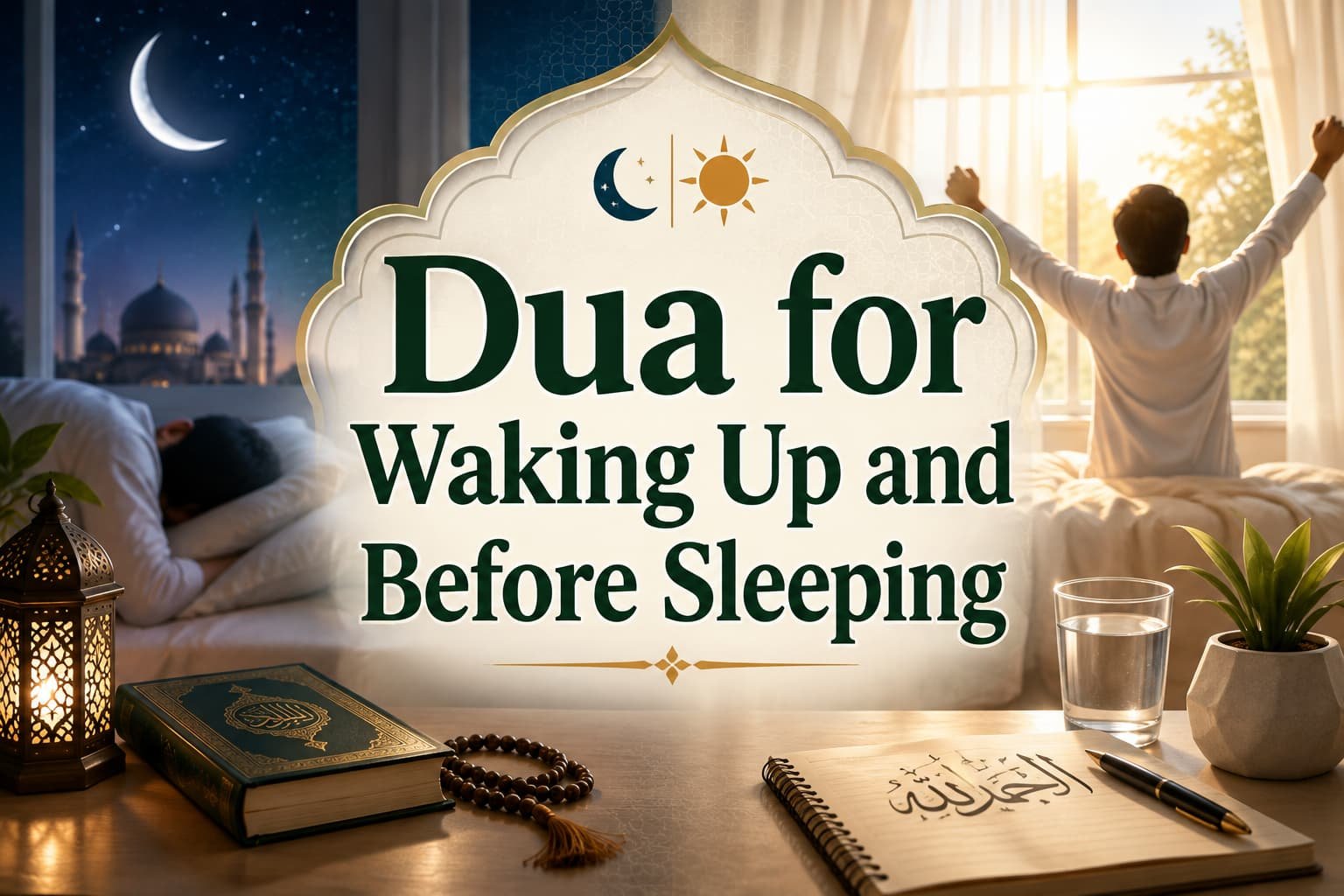
If you have ever wondered exactly what the Prophet ﷺ said before closing his eyes at night, and what he said the moment he opened them again, you are asking a question with a clear, well-documented answer. These are not obscure practices. They come from some of the most authentic hadith collections in Islam, and they take only a few seconds to learn.
The Quran describes sleep and waking as signs of Allah’s power, and the Prophet ﷺ left behind a complete, practical pattern of remembrance for both moments — words to say, a position to sleep in, and a handful of short practices that turn an ordinary night into an act of worship. This article walks through the exact duas, their meaning, the evidence behind them, the etiquettes that go with them, and a few common mistakes worth avoiding.
Why Sleep and Waking Hold Spiritual Significance in Islam
The Quran does not treat sleep as a neutral biological event. It draws a direct comparison between sleep and death:
اللَّهُ يَتَوَفَّى الْأَنفُسَ حِينَ مَوْتِهَا وَالَّتِي لَمْ تَمُتْ فِي مَنَامِهَا ۖ فَيُمْسِكُ الَّتِي قَضَىٰ عَلَيْهَا الْمَوْتَ وَيُرْسِلُ الْأُخْرَىٰ إِلَىٰ أَجَلٍ مُّسَمًّى ۚ إِنَّ فِي ذَٰلِكَ لَآيَاتٍ لِّقَوْمٍ يَتَفَكَّرُونَ
“Allah takes the souls at the time of their death, and those that do not die [He takes] during their sleep. Then He keeps those for which He has decreed death and releases the others for a specified term. Indeed, in that are signs for a people who give thought.”
Surah Az-Zumar 39:42
Classical commentators, including Ibn Kathir, explain that this verse describes two kinds of “taking back” — the greater one at actual death, and the lesser one that happens every time a person falls asleep. The soul is, in a real sense, withdrawn for the night and returned in the morning only by Allah’s permission. The Quran also frames sleep itself as one of Allah’s signs, alongside the daily search for provision:
وَمِنْ آيَاتِهِ مَنَامُكُم بِاللَّيْلِ وَالنَّهَارِ وَابْتِغَاؤُكُم مِّن فَضْلِهِ ۚ إِنَّ فِي ذَٰلِكَ لَآيَاتٍ لِّقَوْمٍ يَسْمَعُونَ
“And among His signs is your sleep by night and day, and your seeking of His bounty. Indeed, in that are signs for a people who listen.”
Surah Ar-Rum 30:23
This theological backdrop explains why the Sunnah treats sleeping and waking as moments that call for conscious remembrance of Allah rather than routine to pass through unthinkingly. Sleep science today studies the body’s natural rest cycle largely through the lens of the circadian rhythm, but from an Islamic angle, the nightly loss and return of consciousness has always carried spiritual weight, not just a physiological one.
The Concept of Sleep as a “Minor Death” in Islamic Teaching
A narration reported through Jabir ibn Abdullah captures this idea directly. When the Prophet ﷺ was asked whether the people of Paradise sleep, he replied that they do not, “because sleep is the brother of death, and the people of Paradise do not die.” This wording is preserved in Tabarani’s collection and other early hadith works rather than in Bukhari or Muslim, and hadith specialists such as Haythami and al-Suyuti have judged its chain of narration sound. It is not a Quranic statement or a report from the two most rigorously verified collections, but it fits naturally with what Surah Az-Zumar already establishes: sleep is a temporary withdrawal of the soul, and the Prophet ﷺ used that reality to teach something practical — that a person should never lie down without first entrusting himself to Allah, since no one truly knows whether that sleep will end in this world or the next.
The Dua Before Sleeping (Full Text, Transliteration, and Meaning)
The primary dua for going to sleep comes from a well-known hadith narrated by Hudhayfah ibn al-Yaman. He reported that whenever the Prophet ﷺ went to bed, he would place his hand under his cheek and say:
بِاسْمِكَ اللَّهُمَّ أَمُوتُ وَأَحْيَا
Bismika Allahumma amutu wa ahya — “In Your name, O Allah, I die and I live.”
Sahih al-Bukhari 6324 · Narrated by Hudhayfah ibn al-Yaman · Grade: Sahih
The meaning is direct: the person going to sleep is placing both his death and his life in Allah’s name, acknowledging that neither is in his own hands. It is a short sentence, easy to memorize in one sitting, and it says something enormous about dependence on Allah in a moment when a person is at their most vulnerable and unaware.
A second, longer dua is authentically reported through a different companion, Al-Bara’ ibn Azib, and it is tied to a specific practice: making wudu before sleep.
اللَّهُمَّ أَسْلَمْتُ وَجْهِي إِلَيْكَ، وَفَوَّضْتُ أَمْرِي إِلَيْكَ، وَأَلْجَأْتُ ظَهْرِي إِلَيْكَ، رَغْبَةً وَرَهْبَةً إِلَيْكَ، لَا مَلْجَأَ وَلَا مَنْجَا مِنْكَ إِلَّا إِلَيْكَ، آمَنْتُ بِكِتَابِكَ الَّذِي أَنْزَلْتَ، وَبِنَبِيِّكَ الَّذِي أَرْسَلْتَ
“O Allah, I submit my face to You, I entrust my affair to You, and I turn my back to You for protection, in hope and in fear of You. There is no refuge and no escape from You except to You. I believe in Your Book which You have revealed, and in Your Prophet whom You have sent.”
Sahih al-Bukhari 247, Sahih Muslim 2710 · Narrated by Al-Bara’ ibn Azib · Grade: Sahih (agreed upon)
The Prophet ﷺ told Al-Bara’ to make these his very last words before drifting off, adding that whoever recites them sincerely and passes away that night dies upon fitrah — the natural state of faith. These are two separate, independently authentic narrations rather than one dua that grew longer over time, and a person is free to use either, or both, depending on the night and how much time they have. The short one is easiest for daily use and for teaching to children; the longer one pairs naturally with the wudu-before-sleep etiquette covered further below.
Hadith Source and Authenticity Status
Both duas above are graded sahih and appear in the two most rigorously authenticated hadith collections in Sunni Islam, Sahih al-Bukhari and Sahih Muslim. Hudhayfah’s narration is recorded in more than one place in Bukhari, sometimes with the phrase order reversed (“ahya wa amut” instead of “amutu wa ahya”). Scholars such as Ibn Hajar al-Asqalani note in his commentary that both orderings are authentic and carry the same meaning — the Prophet ﷺ simply varied the wording on different nights, and either order is correct to recite.
Placing the Hand Under the Cheek — A Prophetic Practice
The same hadith from Hudhayfah describes a small physical detail alongside the words: the Prophet ﷺ would rest his hand under his cheek as he lay down. Scholars treat this as a simple Sunnah of physical etiquette that accompanies the verbal dua rather than a separate ritual in its own right — a natural, comfortable resting position that happens to carry the extra reward of following the Prophet’s ﷺ own habit.
The Dua Upon Waking Up (Full Text, Transliteration, and Meaning)
The same hadith that gives us the sleeping dua also gives us its companion — what the Prophet ﷺ said the moment he woke up:
الْحَمْدُ لِلَّهِ الَّذِي أَحْيَانَا بَعْدَ مَا أَمَاتَنَا وَإِلَيْهِ النُّشُورُ
Alhamdu lillahil-ladhi ahyana ba’da ma amatana wa ilayhin-nushur — “All praise is for Allah who gave us life after having taken it from us, and unto Him is the resurrection.”
Sahih al-Bukhari 6324 · Narrated by Hudhayfah ibn al-Yaman · Grade: Sahih
The wording treats every morning as a small resurrection. Sleep took away conscious awareness; waking restores it, and the dua responds to that restoration with gratitude rather than taking it for granted. It also plants a reminder of the real Resurrection at the very start of the day, before anything else has been said or done.
Additional Authentic Morning Remembrance Immediately Following Waking
Ibn Abbas narrated that he once stayed overnight at the home of his aunt Maymunah, wanting to observe how the Prophet ﷺ prayed at night. He reported that the Prophet ﷺ slept until around midnight, then woke, wiped the traces of sleep from his face with his hand, and recited the final ten verses of Surah Aal-Imran before rising to perform wudu and pray.
“Allah’s Messenger ﷺ slept till the middle of the night, then woke up, rubbing the traces of sleep off his face with his hands. He then recited the last ten verses of Surah Aal-Imran, got up, and went to a hanging water-skin, performed a perfect ablution, and stood up to pray.”
Sahih al-Bukhari 183 · Narrated by Ibn Abbas · Grade: Sahih
This particular report describes the Prophet ﷺ waking specifically for night prayer rather than describing a general morning routine, so it is best understood as a practice tied to waking for Tahajjud rather than a mandatory addition every single time someone opens their eyes. Imam an-Nawawi drew from this hadith that reciting these closing verses of Aal-Imran upon rising at night is mustahabb — recommended, not obligatory. Readers who want the fuller sequence of remembrances said after Fajr can explore the site’s complete morning adhkar routine, which picks up naturally from this point in the day.
The Wisdom Behind These Duas (Tafsir and Scholarly Explanation)
Why would the Prophet ﷺ tie two such ordinary moments — falling asleep and opening your eyes — to remembrance of death and resurrection? Commentators on Sahih al-Bukhari, including Ibn Hajar al-Asqalani in his monumental commentary Fath al-Bari, point to the placement of these hadith in the “Book of Invocations” as deliberate. Every action in a believer’s day, from the smallest to the largest, has an accompanying remembrance attached to it, and sleep is treated as no exception simply because it feels automatic.
The educational purpose is straightforward: cultivating constant God-consciousness, or taqwa, by refusing to let even unconscious hours pass without acknowledging Allah. A person who says these words nightly is training a habit of returning to Allah at the start and end of every cycle of the day, not only during the five daily prayers. Ibn Hajar (a fifteenth-century Shafi’i hadith scholar whose commentary remains one of the most referenced explanations of Sahih al-Bukhari to this day) makes the point that Imam Bukhari’s own arrangement of these hadith — closing the Book of Ablution with the theme of death, and later dedicating chapters of the Book of Invocations to sleep — was itself meant to remind the reader that every night’s rest is a rehearsal for the final one.
Related Sunnah Etiquettes for Sleep
Beyond the two main duas, the Prophet ﷺ taught a small set of practical habits around sleep. None of them takes more than a minute, and together they form a complete nightly routine grounded in authentic hadith.
- Performing wudu before sleeping. Al-Bara’ ibn Azib reported that the Prophet ﷺ told him: “Whenever you go to bed, perform ablution like that for prayer, then lie on your right side” — the same hadith that carries the longer sleeping dua above (Bukhari 247, Muslim 2710). For a full walkthrough of the steps, see the site’s guide on how to perform wudu correctly.
- Sleeping on the right side. The same hadith instructs lying down on the right side after making wudu, a position several scholars have also connected to physical comfort and ease of waking for the night or Fajr prayer.
- Dusting off the bed before lying down. Abu Huraira reported that the Prophet ﷺ said: “When one of you goes to his bed, let him dust it off with the inside of his lower garment, for he does not know what came onto it after he left it,” followed by the words: “In Your name, my Lord, I lie down, and in Your name I rise. If You take my soul, then have mercy on it, and if You return it, then protect it as You protect Your righteous servants” (Sahih al-Bukhari 6320, Sahih Muslim 2714).
- Reciting Ayat al-Kursi before sleep. A well-known narration from Abu Huraira describes a guardian being appointed over anyone who recites this verse before sleeping, with protection from Satan until morning (Sahih al-Bukhari 2311). It pairs naturally with the last two verses of Surah Al-Baqarah, which carry their own authentic narration about being “sufficient” protection for the night.
- Reciting the three Quls and blowing into the hands. Aisha reported that the Prophet ﷺ would cup his hands, recite Surahs Al-Ikhlas, Al-Falaq, and An-Nas, blow into his palms, and then wipe them over his head, face, and body — repeating this three times each night (Sahih al-Bukhari 5017).
Reciting Ayat al-Kursi and the Three Quls Before Sleep
The Ayat al-Kursi hadith has an unusual origin story. Abu Huraira was placed in charge of guarding the charity food collected during Ramadan when a thief appeared three nights in a row, stealing from the stockpile. On the third night, Abu Huraira caught him and refused to let go until the thief offered something in exchange: teach him words that would protect him until morning if recited before sleep — Ayat al-Kursi. The Prophet ﷺ later confirmed that the thief, who turned out to be Satan himself, had told the truth “although he is a liar.” For a fuller look at this narration and the verse’s other reported virtues, the site’s guide on the virtues of reciting Ayat al-Kursi before sleep covers it in more depth.
The three Quls practice, from Aisha’s narration, has its own protective purpose and is closely related to broader teachings on seeking Allah’s protection through recitation — a theme covered more broadly in the article on authentic duas for protection through the night. Some households also incorporate the Tasbih of Fatimah — thirty-three declarations of Subhan Allah, thirty-three of Alhamdulillah, and thirty-four of Allahu Akbar — which the Prophet ﷺ specifically taught his daughter Fatimah to say at bedtime as a source of daily strength.
Common Mistakes to Avoid
- Reciting the words as a ritual formula without any thought behind them. The duas were meant to be understood, not just recited on autopilot.
- Mixing up the sleeping and waking duas, or reciting the waking dua before bed out of habit. They carry different meanings and are meant for different moments.
- Saying only the dua while skipping the accompanying etiquettes — wudu, dusting the bed, sleeping on the right side — as if the words alone were the entire Sunnah.
- Relying on unverified “extra” duas that circulate online without any real sourcing. If a dua cannot be traced to an authentic hadith, it is safer to stick with the ones that are firmly established.
Practical Guidance for Making These Duas a Daily Habit
Memorizing a short Arabic phrase is easier than it sounds. Start by saying “Bismika Allahumma amutu wa ahya” out loud every night for a week, even if you need to read it off your phone at first. Once it becomes automatic, add the waking dua the same way. Reciting audibly, rather than silently in your head, tends to help the words stick faster.
With children, begin with the short sleeping dua alone before introducing anything else — it is only a few words and easy for a young child to repeat back. A bedside reminder, whether a sticky note or a small card, can help both adults and children stay consistent during the first few weeks before it becomes second nature.
None of this needs to feel like an isolated nightly ritual bolted onto the end of the day. It fits into the broader habit of dhikr that many Muslims already build around the five daily prayers, and it connects naturally with the wider set of everyday supplications covered in the complete guide to daily duas.
Frequently Asked Questions
What if I forget to say the dua before falling asleep?
There is no sin in forgetting. If you remember before you actually drift off, say it then. If you only remember after waking up, simply resume the habit the next night rather than treating the missed night as a failure. Consistency over time matters far more than never once missing it.
Is it necessary to say the dua in Arabic, or can I say it in my own language?
The specific reward described in the hadith is tied to the Prophet’s ﷺ own Arabic wording, and the phrase is short enough that most people can memorize it within a few days. That said, if you cannot yet pronounce the Arabic, supplicating in your own language is valid — Allah hears every sincere prayer regardless of the language it is said in. Many people simply learn the short Arabic dua first and build from there.
What is the difference between the short and long versions of the sleeping dua?
They are not the same dua in two lengths — they come from two separate, independently authentic hadith. The short version, “Bismika Allahumma amutu wa ahya,” is from Hudhayfah’s narration and works well as a quick nightly habit. The longer version, beginning “Allahumma aslamtu wajhi ilayka,” is from Al-Bara’ ibn Azib’s narration and is specifically tied to making wudu before sleep. You can use either one, or both on nights you have the time.
Can women recite these duas during menstruation?
Yes. The sleeping and waking duas covered in this article are dua and dhikr, not Quran recitation, so there is no restriction on saying them during menstruation. Ayat al-Kursi is different, since it is a Quranic verse, and scholars genuinely differ over whether reciting Quran during menstruation is permitted — some restrict it, while others hold that recitation itself is not clearly prohibited, only touching the physical mushaf without a barrier. For the fuller picture on worship during menstruation, see the guide on rules of worship during menstruation.
Is there a specific dua for waking up in the middle of the night?
Yes. Ubada ibn as-Samit reported that the Prophet ﷺ said whoever wakes during the night and recites the tahlil and tasbih formula — “La ilaha illallah wahdahu la sharika lah, lahul-mulku wa lahul-hamdu, wa huwa ‘ala kulli shay’in Qadir…” — and then asks Allah for forgiveness or makes a supplication, will be answered. If he then performs wudu and prays, his prayer will be accepted (Sahih al-Bukhari 1154). This is a separate narration from the general sleeping and waking duas above, meant specifically for waking briefly during the night.
Do children need to be taught a simplified version?
Starting with just the short sleeping dua is usually enough for a young child. Once they have it memorized and are saying it comfortably, you can introduce the waking dua, and later the other etiquettes, one at a time. Gentle repetition and encouragement work far better than pressure.
Conclusion
Sleeping and waking are not neutral, unconscious moments in a Muslim’s day. They are two of the smallest, most repeated opportunities a person has to remember Allah and reflect on mortality and resurrection — and the Prophet ﷺ made sure no one had to guess at how to use them well.
Start with the short dua tonight. Add the waking dua tomorrow morning. Build the rest of the etiquettes in gradually, one at a time, rather than trying to adopt all of them at once. Consistency, even in small and imperfect steps, is what turns these words from information into habit.